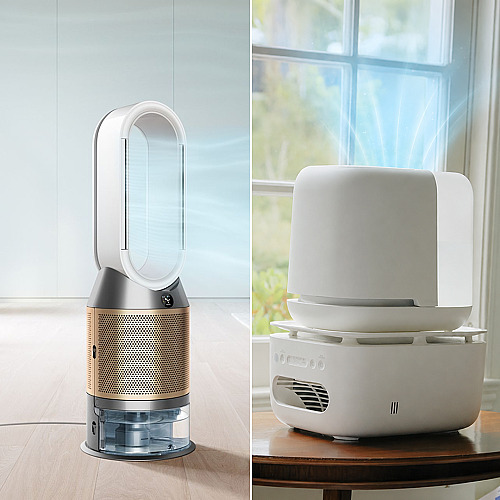
If you’ve been shopping for a bedroom air purifier and humidifier combo, the Dyson Purifier Humidify+Cool PH2 De-NOx has probably come up. It’s a well-designed product from a brand with serious name recognition, and at $1,099.99, it’s priced like a statement piece (Note: Availability varies by colorway; check dyson.com for current stock). But there’s another option gaining ground among design-conscious homeowners who’ve done the math: the Canopy All-in-One Humidifier & Purifier, at $358.
That’s a $742 difference. We put both products through seven comparison criteria to help you figure out where that money goes.
1. Two Towers, Two Design Philosophies
Canopy All-in-One Humidifier & Purifier
The Dyson Purifier Humidify+Cool PH2 De-NOx is a single, integrated unit. One tower handles air purification, humidification, and cooling in a sealed loop design. It’s tall (approximately 36 inches), visually distinctive, and weighs roughly 18 pounds.
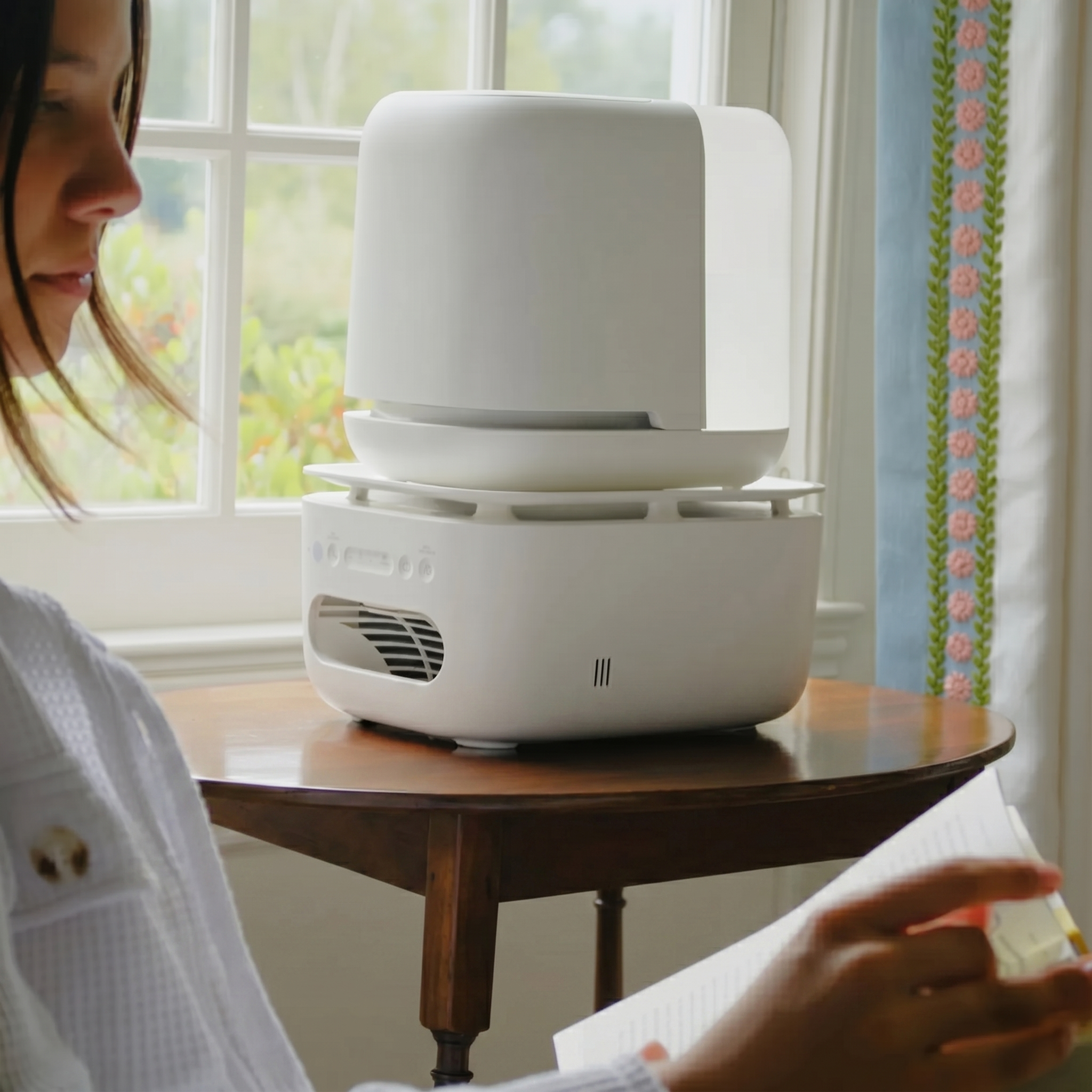
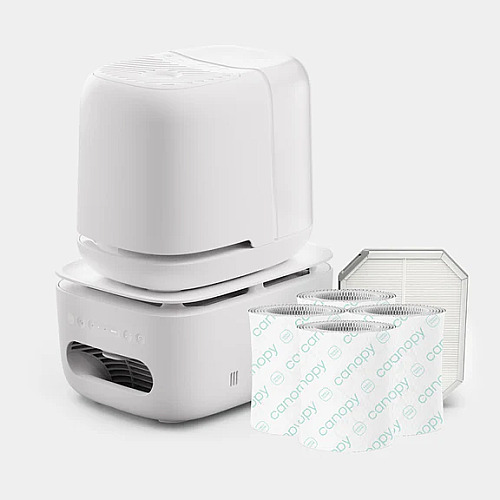
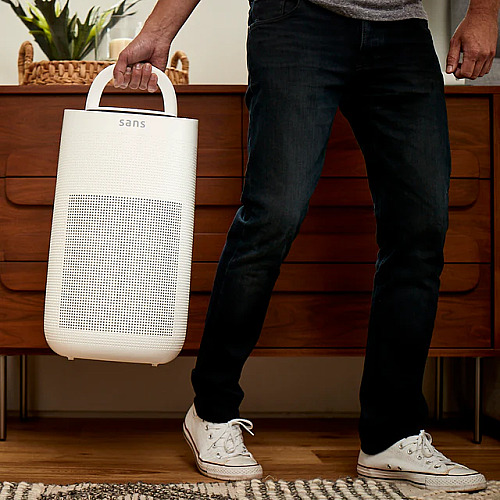
Canopy’s approach is fundamentally different. The All-in-One Humidifier & Purifier stacks two independent devices (an air purifier and a humidifier) into a single nightstand-friendly footprint. Together, they weigh roughly seven pounds. Each device can also be used on its own. It’s a small detail with real-life implications:
Move the air purifier to a home office while the humidifier stays in the bedroom.
Run just the humidifier while you travel.
Upgrade or replace one component when needed, without replacing the whole system.
Both Canopy devices include built-in aromatherapy. The Dyson does not.
2. Maintenance Without the Drama
Canopy Humidifier
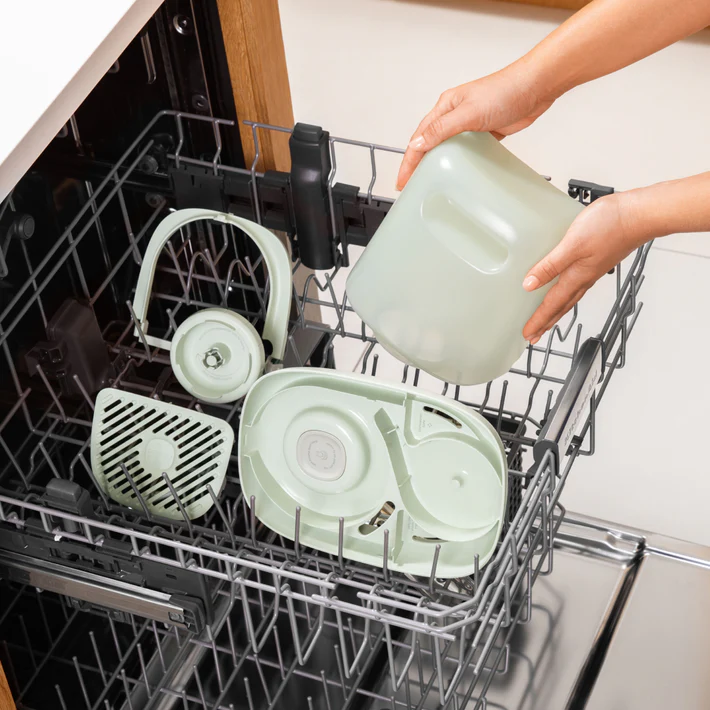
Humidifiers earn a bad reputation, and the culprit is almost always upkeep. Water tanks can accumulate gunk when neglected, and most users end up cleaning their devices less often than they should.
Canopy’s All-in-One Humidifier & Purifier uses dishwasher-safe components. Rinse, load, run. For anyone who has ever wrestled with a narrow tank opening and a bottle brush, that’s not a small thing.
Dyson takes a guided approach. Once a month, the PH2 guides you through a deep-clean cycle using 150g of citric acid to flush mineral buildup from the internal water system. The citric acid isn’t included and must be sourced separately, either on your own or through Dyson’s cleaning kit. It’s more involved than a dishwasher run, but the machine walks you through each step.
Cleaning complexity is one of the top reasons humidifiers get abandoned. It’s worth knowing what you’re signing up for.
3. Filtration and Hygiene
Canopy Air Filter
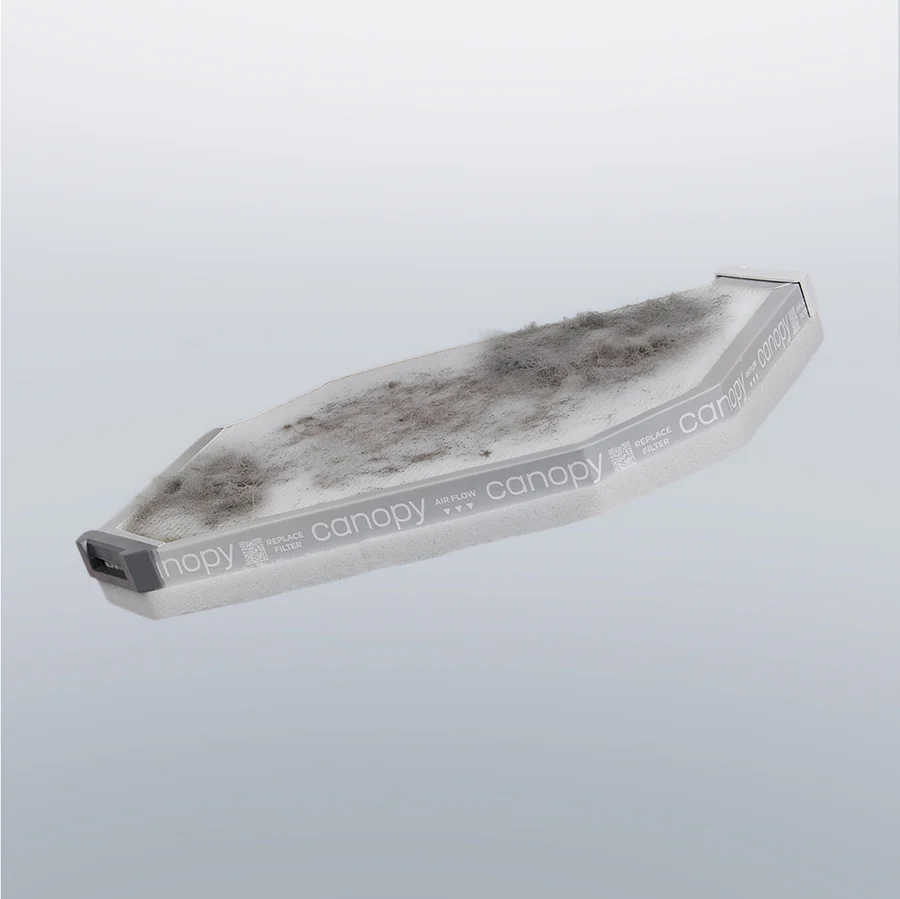
Both products use HEPA-13 filtration, capturing up to 99.97% of airborne particles as small as 0.3 microns*. On particle filtration, they’re equivalent. Where they diverge is in what each brand prioritizes beyond that baseline.
Air Filtration
Dyson goes further with K-Carbon to capture nitrogen dioxide (NO₂) and a catalytic filter for continuous formaldehyde destruction, meaningful upgrades for households in high-traffic urban environments. Canopy adds an activated carbon layer to its HEPA-13 filtration to address common household odors and gases.
Water Quality and Mold Inhibition
Both products also treat the water they humidify. What enters the air starts with what’s in the tank.
Canopy’s All-in-One Humidifier & Purifier runs water through a MERV 5 pre-filter and antimicrobial core** before evaporation and includes a mold-inhibiting design† inside the humidifier:
Smart Persistent Airflow (SPA)™: If water is detected inside the device, the fan runs automatically to inhibit mold growth†, even when the humidifier isn’t actively in use.
UV light: Water passes through ultraviolet light before evaporation.
Antimicrobial filter materials: The filter inhibits microbial growth† between replacements.
To be clear, these features target mold growth inside the machine, not in your room.
Dyson uses its Ultraviolet Cleanse technology to handle both water sterilization and hygiene in one step. Every drop passes through a λ275nm UV light before evaporation, which Dyson says kills 99.9% of bacteria in the water.
4. Smart Features
Dyson
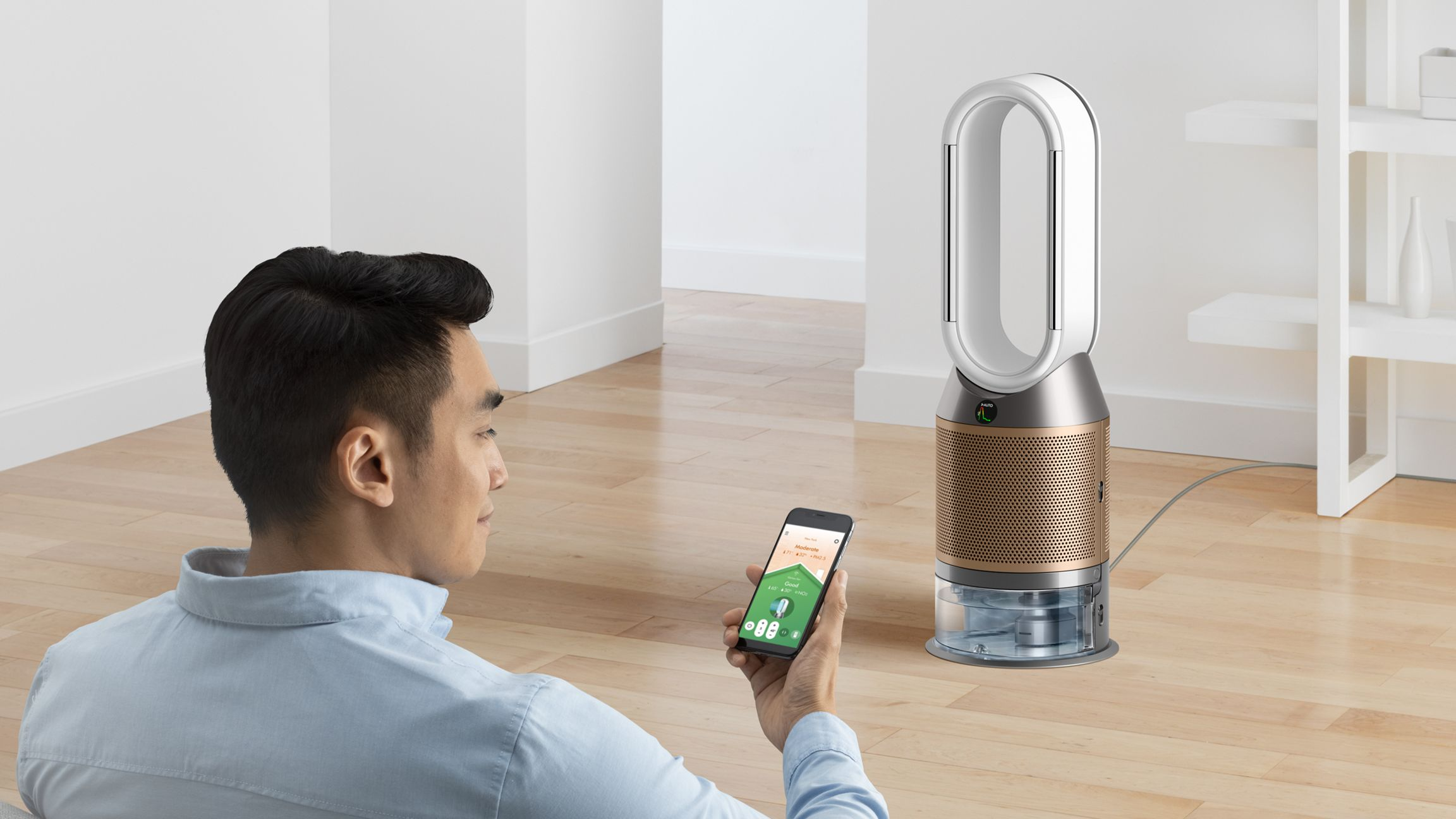
Dyson has a clear lead here. The PH2 offers a full smart home ecosystem:
MyDyson app connectivity for real-time air quality monitoring and scheduling
Works across Apple Home, Google Home, and Amazon Alexa via Matter
Voice control support
Remote control from anywhere
If your home runs on automations, the PH2 fits right in.
Canopy is app-free by design. No Bluetooth, no Wi-Fi, no added screen time. The All-in-One Humidifier & Purifier positions this intentionally: “Fresher air without the complicated setup, Bluetooth, or extra screen time.”
5. Cooling
Dyson
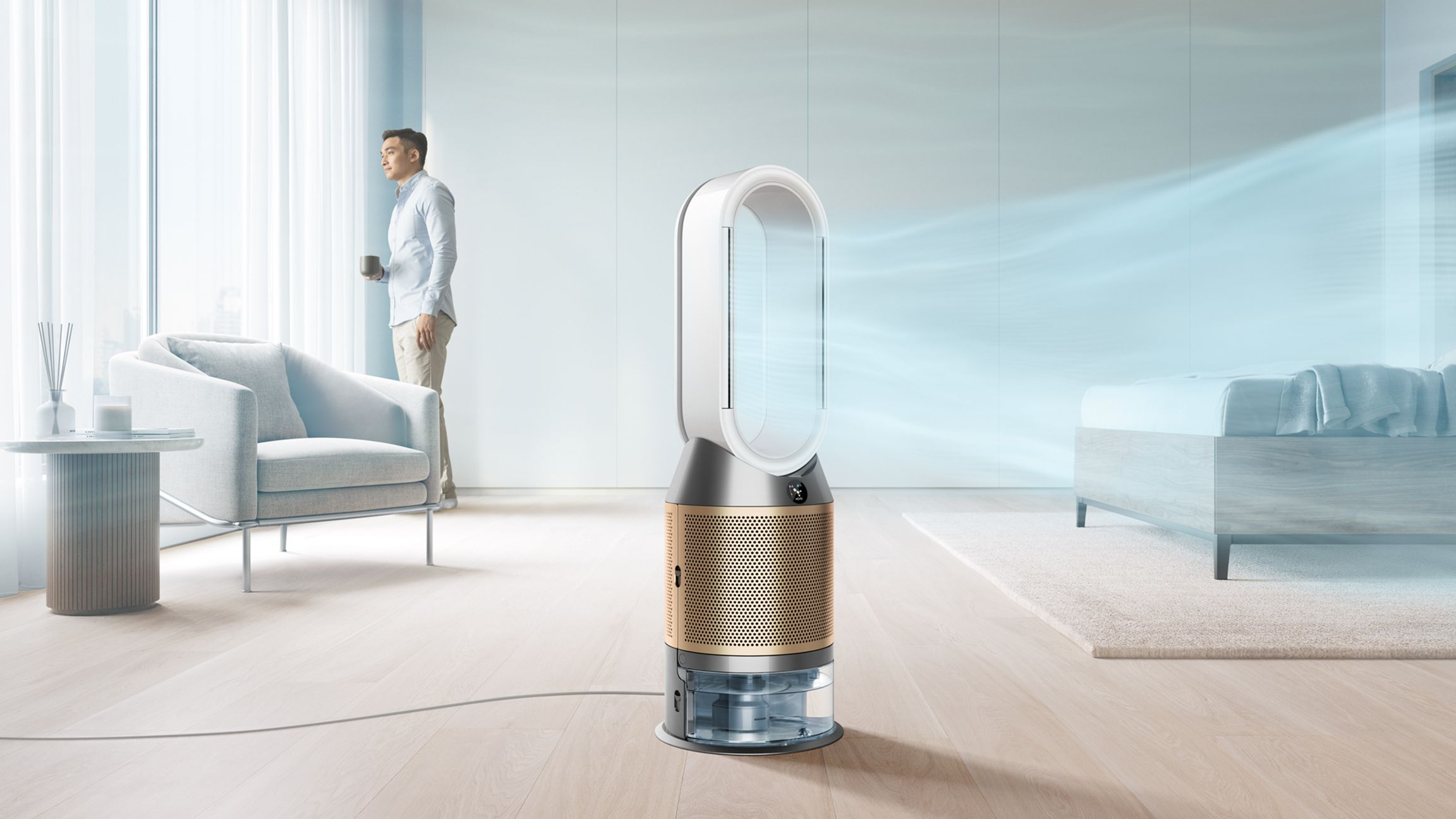
Of the two products, only the Dyson Purifier Humidify+Cool PH2 De-NOx includes dedicated air circulation as a feature.
Dyson’s Air Multiplier technology draws air through the base and amplifies it up to 15 times through a looped design, producing a smooth, powerful stream of circulated air. It circulates air powerfully but does not lower room temperature. Think of it as a very strong fan, not a cooling system.
The All-in-One Humidifier & Purifier does not list cooling as a feature. What it does deliver, as a byproduct of evaporative humidification, is a mild cooling effect through moisture evaporation.
6. Sleep Performance
Canopy
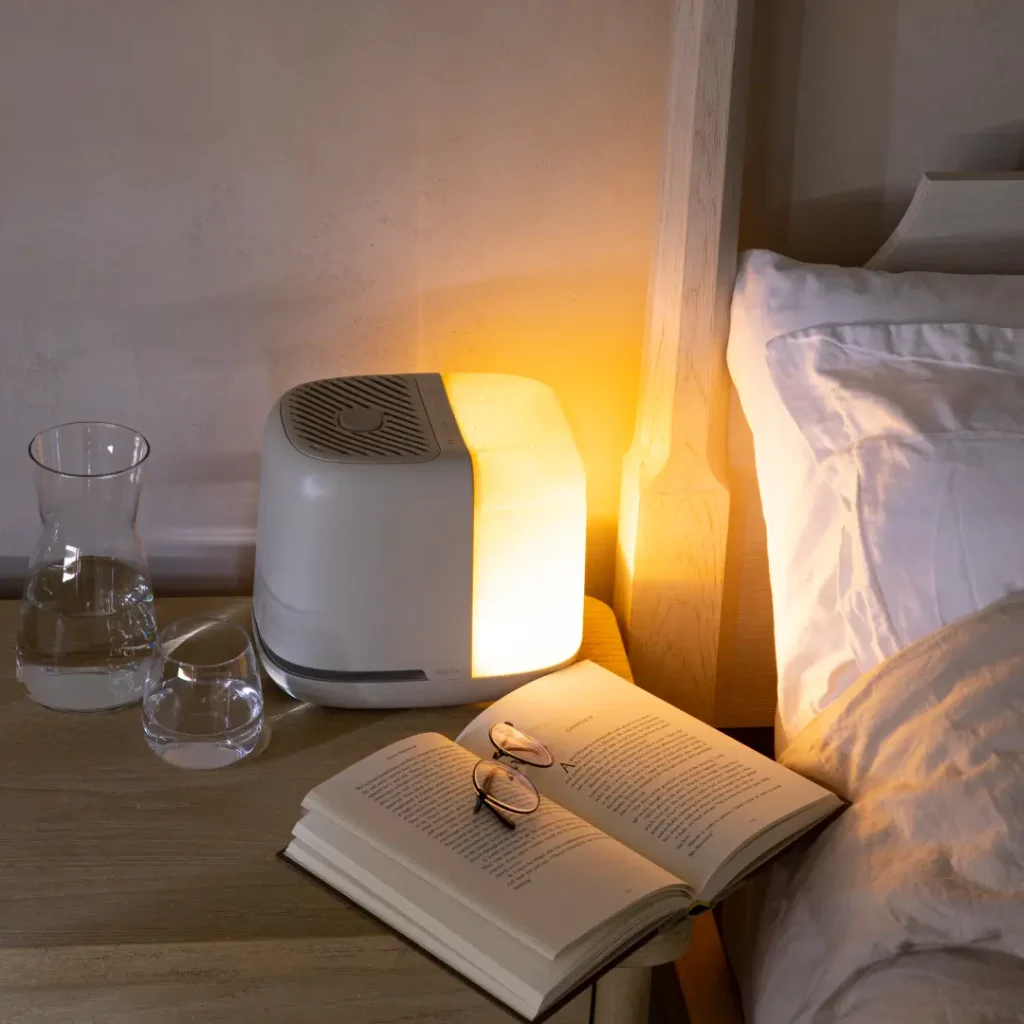
Noise matters in a bedroom. At maximum output, the Canopy air purifier reaches 50 dB, and the Dyson PH2 reaches 62.4 dB, per Dyson’s international specification page. Canopy’s low end drops to 17.5 dB. Dyson doesn’t publish a low-end figure on its US product page.
The Canopy’s sleep toolkit goes beyond noise:
Sleep-Safe Auto Mode holds fan speed constant after lights go down, keeping the sound environment consistent through the night
Built-in nightlight for low-impact visibility (Red and White, Dimmable)
Three white noise soundscapes included
Built-in aromatherapy, so you can add a sleep scent without a separate diffuser
In a Canopy consumer study, 78% of Air Purifier users reported improved sleep.‡
The Dyson offers LCD screen dimming but no white noise. Its auto mode adjusts fan speed in response to real-time air quality readings, which can mean audible changes while you sleep.
7. The $742 Question
At $358 for the Canopy All-in-One Humidifier & Purifier and $1,099.99 for the Dyson Purifier Humidify+Cool PH2 De-NOx, the difference is $742. You could outfit a bedroom, a nursery, and a home office for roughly what one Dyson costs.
The Dyson earns its price in specific areas:
Gas-phase filtration for urban air pollutants (NO₂ and formaldehyde)
A full smart home ecosystem with app, Matter, and voice control
Air Multiplier cooling for warmer months
For households where those needs are real, it’s a justifiable investment.
For the majority of homeowners buying for a bedroom, the All-in-One Humidifier & Purifier covers the primary concerns at less than a third of the cost:
Sleep performance, with consistent fan speed, white noise, and a quiet operating range
Easy maintenance with dishwasher-safe parts
Mold-inhibiting design†
Fresher air, with 91% of Air Purifier users in a Canopy consumer study saying the space feels less stuffy and 91% reporting feeling more relaxed‡
A Few More Comparison Points
Canopy All-in-One Humidifier & Purifier | Dyson Purifier Humidify+Cool PH2 De-NOx | |
|---|---|---|
Form Factor | Stackable two-device tower | Single integrated tower |
Weight | ~7 lbs combined | ~18 lbs |
Tank | 2.5L | ~3.8L |
Runtime | Up to 36 hrs | Up to 36 hrs |
Colors | 4 | 2 |
Room Coverage | 416 sq ft (purifier) / 500 sq ft (humidifier) | Not published on US product page |
Noise | 17.5–50 dB | 62.4 dB max |
Aromatherapy | Built-in on both devices | No |
Price | $358 | $1,099.99 |
Which One Is Right for You?
Both products do what they say. The $742 gap between the Canopy All-in-One Humidifier & Purifier and the Dyson Purifier Humidify+Cool PH2 De-NOx is real. Whether it’s justified depends on which column looks more like your life.
If the answer is simpler air, better sleep, and a device that stays clean without much thought, the Canopy All-in-One Humidifier & Purifier was designed with exactly that in mind.
See what $358 can do for your space!
*Tested to ISO 29463 standards.
**The filter media has been treated with an antimicrobial agent to inhibit fungal growth within the product. This treatment does not protect users or others against bacteria, viruses, germs, or other disease organisms.
† Mold inhibiting features only in reference to mold inhibiting within the device and does not make any claim of inhibition of mold in the environment or air. Mold inhibition test completed by third-party lab. Tested to ATCC 6275 and ATCC 16404 with Aspergillus niger.
‡Based on an external Consumer Perception Study of 47 participants after 30 days. Results may vary.


Leave a Comment
Your email address will not be published. Required fields are marked *